Date: 08 Jul 2026
Agricultural Machinery and Equipment Latest 2027 Launch
The Mechanisation Gap Nobody Has Closed
Africa has roughly a quarter of the world's arable land and something under 5% of its agricultural machinery. Tractor density across much of sub-Saharan Africa sits in low single digits per 100 square kilometres of cropland, against figures that are twenty to fifty times higher in Asia. That gulf is usually presented as a development statistic. From a manufacturing and export standpoint it is something else entirely: a structural, decade-long demand curve that has barely begun.
But there is a trap inside that opportunity, and it has caught a lot of exporters. Machinery graveyards exist across the continent — rows of tractors and implements, some barely used, immobilised by a single unavailable part or a specification that never suited the soil in the first place. Africa does not have a machinery acquisition problem so much as a machinery survival problem.
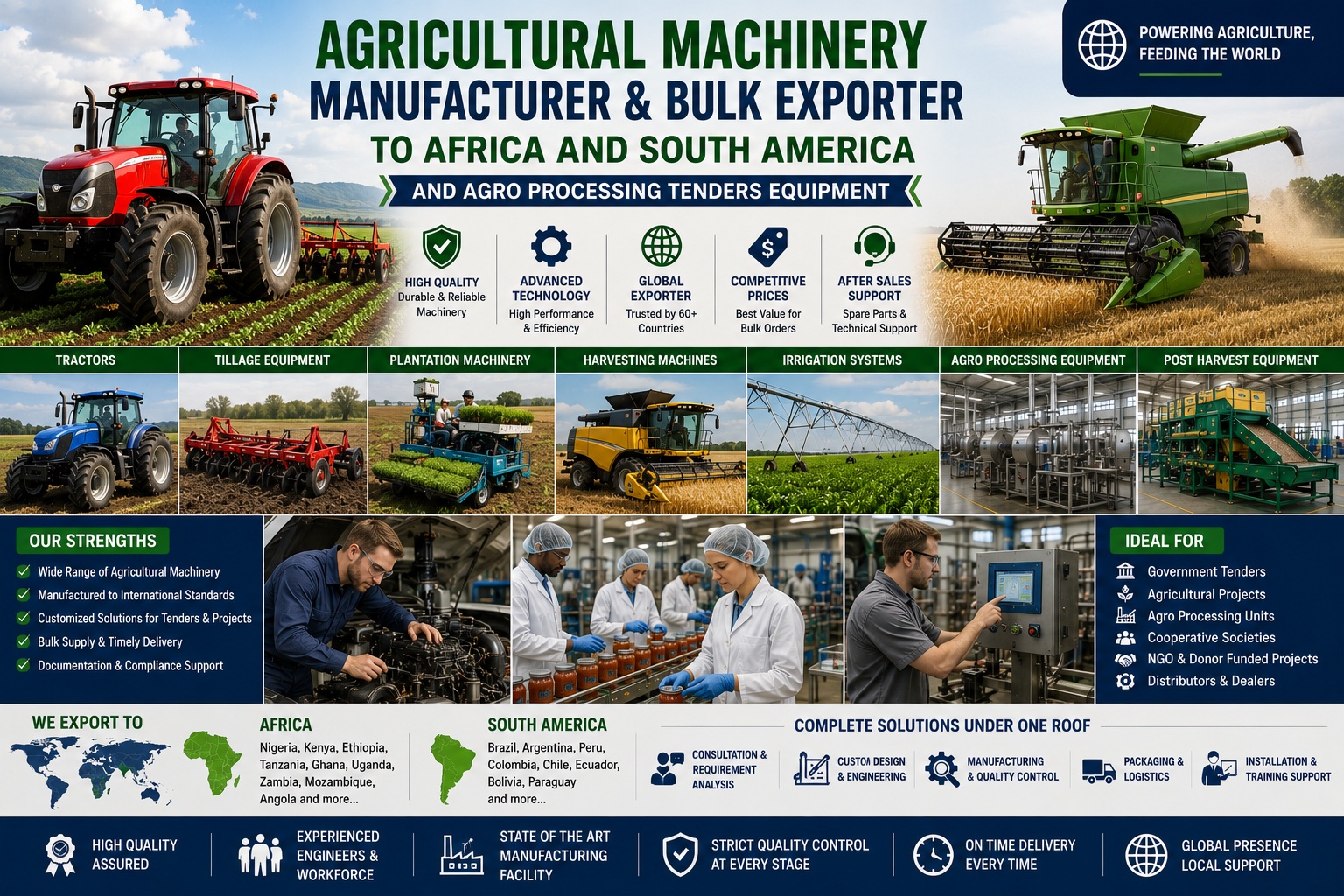
We manufacture agricultural machinery for the survival test, and we supply it in bulk to importers, government programmes, cooperative unions and agro-dealers across ten priority markets.
Where the Demand Actually Sits
Ethiopia runs one of the continent's most ambitious mechanisation agendas, with heavy demand for threshers, harvesters, tillage implements and irrigation-linked equipment for teff, wheat and sesame. Procurement is frequently programme-driven and volume-heavy.
Nigeria has both a large-scale commercial farming segment and a vast smallholder base, plus state-level agricultural mechanisation schemes that buy in fleets. Rice, maize, cassava and sorghum dominate. Demand skews toward power tillers, threshers, planters and harvesting equipment.
Kenya and Tanzania together anchor East African demand — maize shellers, sunflower and sesame equipment, forage choppers, and a strong market for two-wheel tractors and matched implements suited to smaller holdings and hillside plots.
Ghana and Côte d'Ivoire buy into cocoa, cassava, rice and maize systems, with growing demand for mechanised planting and post-harvest handling as labour costs rise and rural labour availability falls.
Egypt and Morocco are irrigation-intensive, high-value-crop economies. Machinery demand centres on precision planting, greenhouse-adjacent equipment, harvesting for citrus, olive and date sectors, and sophisticated water-linked systems.
Algeria procures largely through tender, with cereals and dates driving specification, and strong preference for suppliers who can meet local documentation and after-sales presence requirements.
South Africa is a commercial, mechanised, standards-driven market where imported machinery competes on total cost of ownership and dealer support rather than headline price.
Zambia, Uganda and Zimbabwe form a strong secondary tier, particularly for maize and soya equipment and for conservation-agriculture implements.
Engineering for African Field Conditions
Here is where manufacturing depth shows.
Soil and abrasion. Lateritic and heavily abrasive soils common across West and Central Africa destroy standard-grade wear parts at rates that shock European-specified equipment. We use boron and high-carbon steels on ground-engaging components, heat-treated to specification, and we design wear parts to be replaceable in the field with common tools — bolted, not welded.
Stone and stump tolerance. Newly opened land is not clean land. Shear-bolt and spring-release protection on tillage implements is not an upsell in these markets; it is the difference between an implement that lasts eight seasons and one that folds in the first.
Frame robustness over weight optimisation. Modern European implement design optimises aggressively for weight. That optimisation assumes prepared fields, skilled operators and prompt maintenance. We deliberately build heavier frames with generous safety factors, because the machine will be operated by a hired driver in a hurry across land that was bush eighteen months ago.
Simple, serviceable power. Where we supply engine-driven units, we favour naturally aspirated, mechanically injected diesels that a rural mechanic can actually service, running on the fuel quality genuinely available at a rural filling station rather than the fuel quality assumed on a European emissions certificate.
Matched implement sets. A common procurement failure is buying tractors and implements from different sources with mismatched hitch categories, PTO speeds and hydraulic capacities. We supply matched packages — power unit, hitch, implement, spares — as a single specification.
Buying in Bulk: How Serious Volume Actually Gets Structured
Bulk agricultural machinery orders in Africa fall into four repeating structures, and each needs different handling:
- Government mechanisation programmes — high volume, tender-based, exhaustive documentation, extended payment terms, frequently donor or development-bank funded. Requires manufacturer's authorisation, financial statements, past-performance evidence and certified technical compliance.
- Cooperative union purchases — dozens of identical mid-size units, often financed through agricultural banks or member contribution. Price-sensitive but highly repeatable.
- Importer and agro-dealer stocking orders — mixed container loads, rapid-moving items, strong emphasis on spares availability and margin structure.
- Commercial estate and outgrower schemes — technically demanding, willing to pay for uptime, sharply focused on service response.
We build our commercial terms around all four. For dealers we offer exclusive territory structures, stocking discounts, technical training and marketing support. For tenders we supply the full documentation package. For cooperatives we structure mixed consignments so a single 40ft container carries a viable multi-machine package rather than one machine and a lot of air.
Conformity, Ports and Payment
Conformity requirements mirror those in the food processing sector: SONCAP for Nigeria, PVoC for Kenya, Tanzania and Uganda, G-CAP for Ghana, GOEIC registration for Egypt, pre-shipment inspection for Algeria. We manage these in-house.
Routing follows the natural corridors: Mombasa for Kenya, Uganda and Rwanda; Dar es Salaam for Tanzania, Zambia, Malawi and DRC's southern trade; Djibouti for Ethiopia; Apapa, Tin Can and Onne for Nigeria; Tema for Ghana; Abidjan for Côte d'Ivoire and Burkina Faso; Durban for South Africa and the SADC hinterland; Alexandria for Egypt.
Payment structures: confirmed irrevocable LC, advance-plus-documents, and where appropriate, buyer-credit arrangements aligned to development finance disbursement schedules. Under AfCFTA, intra-continental distribution from a regional hub is becoming a genuinely attractive structure for large importers — worth discussing if your volumes support it.
The Spares Doctrine
Every consignment we ship includes a wear-part and critical-spares kit sized to the expected first two seasons of operation. Every machine ships with an illustrated parts catalogue carrying part numbers and material specifications, so a competent local workshop can fabricate or cross-source a non-critical item rather than idling the machine.
We would rather sell you a machine that runs for ten years and generates three follow-on orders than a machine that sells easily and dies quietly. That is the entire commercial thesis.
Frequently Asked Questions
Do you supply tractors as well as implements? We manufacture and supply a range of agricultural machinery and matched implement packages. Specification is built around your crop, soil type, holding size and available power.
Can you meet public tender requirements in Africa? Yes — manufacturer's authorisation letters, technical compliance schedules, certified drawings, quality certifications and past-performance references are provided as standard.
What after-sales support is available? Commissioning support, operator and technician training, illustrated parts catalogues, spares supply and remote technical support. Distributor partners receive in-depth service training.
What is the minimum order for bulk pricing? Bulk pricing generally applies from full-container-load quantities. Mixed consignments across our product categories can be combined to reach FCL efficiency.
Do you customise machinery for specific crops? Yes. Crop-specific configuration — screens, sieves, spacings, cylinder speeds — is standard practice, not a special request.
CONTACT US: Send your crop, hectarage, soil type and destination port. We will return a matched machinery package, spares schedule and landed-cost indication.